This is not a trimming technique or a hoof care method; It describes the Physics and the Laws of Nature that all techniques and methods must apply to because if physics doesn’t apply to horses, you can be sure they would fly.
Purpose
This section is not scientific and is only designed to provide you with a foundation that makes it possible for you to succeed with the rehabilitation of hoof problems that are common in foundered horses. It is much more important toessential to secure a positive outcome if your horse or pony founders. You should also know that no horse has ever died from either common founder or laminitis. (I will explain why I said “common founder” further down) It is the lack of successful rehabilitation of “coffin bone rotation”, which is a side effect of laminitis, that far too often leads to the completely unnecessary loss of lives associated with founder.
Founder
Even though research on founder has been going on for many decades, we still don’t know much about it. We know about common reasons for founder, and we know how to trigger a founder reaction in a clinic. Founder is not even a well-defined illness; it is a combination of issues that must be present simultaneously, without other issues being present at the same time. Partly due to this, the word “founder” is often confused with different kinds of intoxications and misused together with laminitis. The connection between founder and laminitis is not fully understood, but what is known is that founder resides in the body and laminitis resides in the hooves. When a horse founders, a substance is released into the bloodstream, and when this substance reaches the hooves, the hooves suffer from laminitis. This makes words like “road-founder” a misunderstanding since road-founder affects the hooves, not the body.
What do we know about the common founder? Most often, founder is triggered when too much sugar has managed to pass through the digestive system and ends up in the large intestine, where it makes the fermentation process go wild, which kills a lot of microorganisms. The microorganisms are essential for the horse since they produce both protein and vitamins, but dead microorganisms turn toxic and can trigger founder. This sugar overload usually happens for one of two reasons: either the horse has eaten too much simple sugars, or he has eaten complex sugars that require special enzymes to be broken down to simple sugars in the small intestine, where they should have been absorbed. The best-known complex sugar is fructan, which green grass produces as freeze protection when the temperature comes close to freezing. It’s also common that commercial feed products contain complex sugars that the horse doesn’t have enough enzymes to break down. It is a common misunderstanding that horses don’t naturally consume sugar, but the truth is that they consume large amounts of simple sugars. This is not a problem as long as they exercise as much as they are meant to, since simple sugars are pure muscle energy. Ordinary hay and grass contain 9-12% simple sugar, and if a horse eats 15 kg = 37 lbs of hay, he will eat at least 1,5 kg = 3.75 lbs of pure sugar per day. That is usually okay for a running horse, but it can be too much for a horse that, for some reason, can’t run. A full gallop burns up to 70x more energy than standing still, which means that 30 minutes of full gallop equals 35 hours standing still when it comes to energy consumption. This is why half an hour of fast gallop, 365 days/year, is considered the best way to prevent founder, even for sensitive horses.
Other known triggers of founder are vaccines and dewormers when used together, and Cortizon. No, stop. Is it proven that Cortizon triggers founder, or just laminitis? That is hard to say since many fail to separate these two. Anyway, don’t use Cortizon on a founder-sensitive horse or pony.
And now right into the lion’s den. There is a kind of founder called “puerperal founder,” or “retained placenta laminitis”, or “postpartum laminitis,” although it originates from when the placenta ruptures and does not completely leave the uterus. The infection makes the mare seriously ill and can lead to a similar kind of bacterial intoxication as the dead microorganisms we were just talking about, and still, it is called “laminitis”. It is, however, very important to keep the “puerperal founder” separate from the common founder since the puerperal founder must be treated with antibiotics, which makes the common founder worse. If the puerperal founder is not treated with antibiotics, there is a serious risk of a fatal outcome, but if the common founder is treated with antibiotics, there is a serious risk of making things worse. As you can see, there is total confusion among the concepts. (It would be much better if I were allowed to decide.)
There is no treatment for common founder, and there is no one needed. The horse usually takes care of it in four days, and the veterinarian
can only offer a foundered horse a painkiller and something anti-inflammatory, but there is neither pain nor inflammation associated with either founder or laminitis in themselves. The pain affecting laminitic hooves comes from a side effect of laminitis, but that is something a good trim takes care of much better and more effectively than drugs can. A horse that has foundered once becomes more sensitive to foundering again. The best you can do for a previously foundered horse is to set him on a tight protocol with extensive daily exercise. Walking or louching is not enough since he will need half an hour of high puls excercise, every day.
Laminitis is a common side effect of Founder.
Laminitis means that the connection between the laminae and the hoof wall corium becomes impaired, which makes the hoof capsule loosen and become very sensitive to ground pressure. This happens gradually; not all lamellae lose grip at the same time.
Over a decade ago, I read a very interesting theory about laminitis from the University of Queensland (UofQ), but I don’t have access to the study, and I can’t get it confirmed (which I find very strange). Since I believe shady forces are affecting the billion-dollar hoof care industry (it might have been detracted without being disproved. I might have seen that with other Australian studies that never got traction.) I have chosen to publish the theory here in the hope of getting it confirmed or disproven. Personally, I don’t care who is right or wrong, only what is right or wrong.
The UofQ theory said that there are anchor cells that connect the secondary lamella to the keratin fibers, and they alternate between grip and let go. Imagine an immense number of cells individually alternating at a high rate between grip and let go. The downward movement of the hoof wall would build up tension in the connections between secondary lamella and keratin fiber that would be released when a cell lets go and be rebuilt again while the cell is in grip mode. In a sound hoof, there would always be enough anchor cells holding tight to secure the hoof wall, being able to do its job, protecting and pumping.
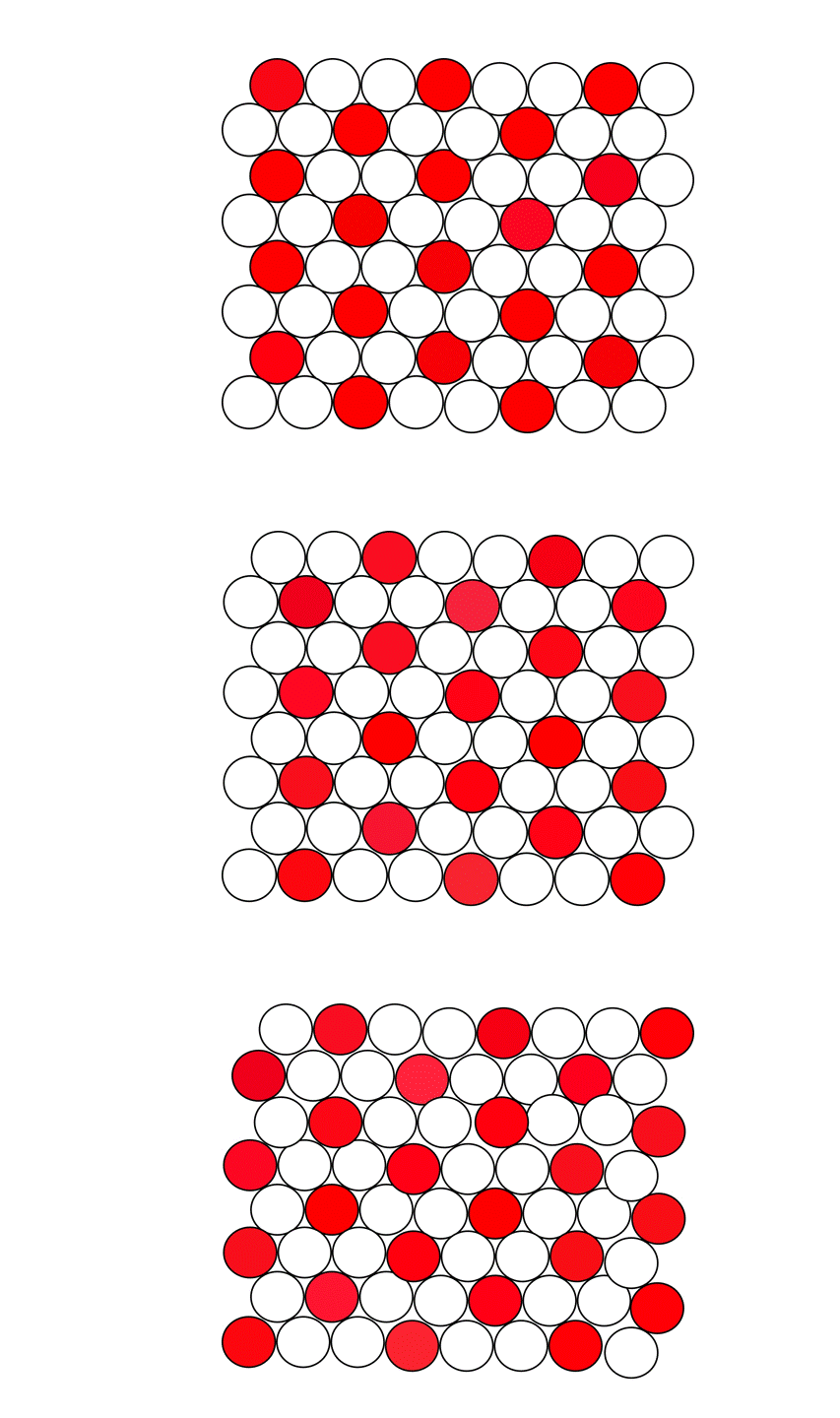
This is the only understandable explanation I have heard for how the hoof wall can grow down while connected to the coffin bone. All other explanations I have heard have been so mysterious that it has been impossible to judge them.
I believe the UofQ theory would also give a clear explanation of what really happens when a hoof suffers laminitis, since I find it reasonable that individual cells could stop alternating when affected by whatever it is that comes with the blood when the horse has foundered.
The UofQ’s theory also explains why a hoof with perfect hoof shape, i.e., without breaking leverage, can heal after laminitis, while a deformed laminitic hoof can’t. A hoof that is not exposed to breaking forces will not be deformed during the four days of acute laminitis, and after laminitis, when the anchor cells start alternating again, they will just grip where they are, and everything is back to normal. If the hoof has been deformed during laminitis, the anchor cells are not in place to grip anything, and the hoof capsule stays loose until it has been replaced.
Remember this theory until we reach the point where laminitic pain originates, and you will see the logic.
Laminitis can be triggered by directly inducing insulin in the hoof, but it’s not known if the laminitic reaction is hormone-related or sugar-related. If the reaction is sugar-related, it must be a lack of sugar, which is the opposite of founder, which is triggered by high sugar intakes. It is well known that horses diagnosed with EMS, which stands for Equine Metabolic Syndrome (or insulin resistance), become prone to laminitis. Insulin resistance (like type 2 diabetes) means that the body doesn’t respond to insulin, which makes it produce more insulin. In real life, this means that EMS horses suffer more or less laminitis all the time since they have too much insulin in their blood all the time.
What happens in the hoof when it gets laminitis?
First, we must understand that laminitis only affects the secondary laminae that are connected between the primary laminae, which are a part of the inside of the hoof wall, and the keratin fibers that create an unstructured network through the corium.
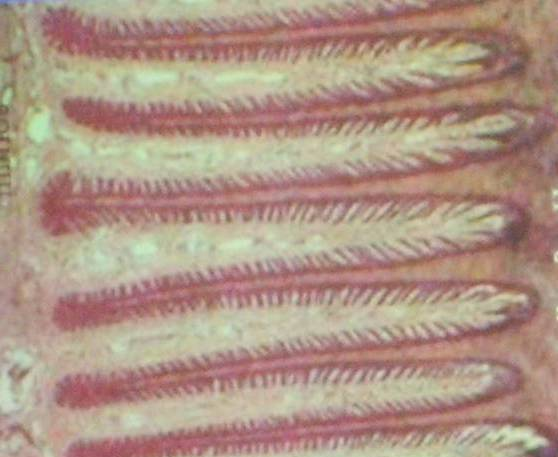
The primary laminae (the red “fingers”) are a part of the inner hoof wall (at the right of the picture). They always point straight out (90 degrees) from the hoof wall, and each one is approximately as thick as a hair in the horse’s tail. What comes from the left side is the blood-filled corium. The short red lines sticking out from the Primary lamella are the secondary lamella, which is much thinner than the primary lamella. Please note that the coffin bone is not visible in the picture above, but it is far to the left.
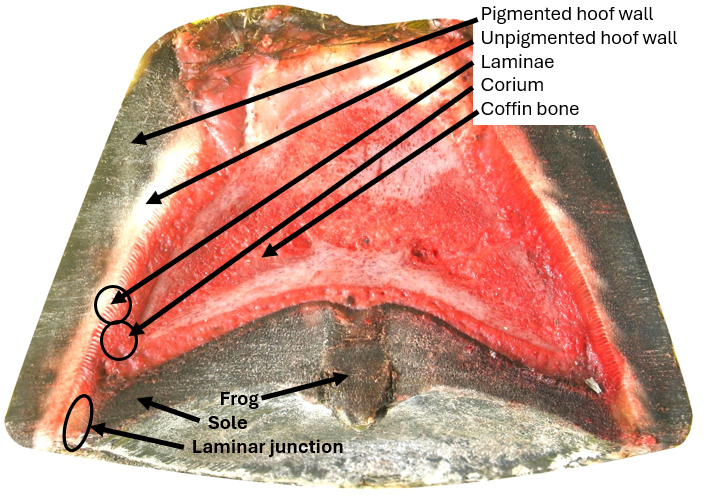
The primary lamina looks like a comb and is always sticking out perpendicular to the hoof wall and into the corium. The corium is criss-crossed with an unstructured network of keratin fibers (green marking below), but there is not a single lamina going all the way from the hoof wall to the coffin bone.
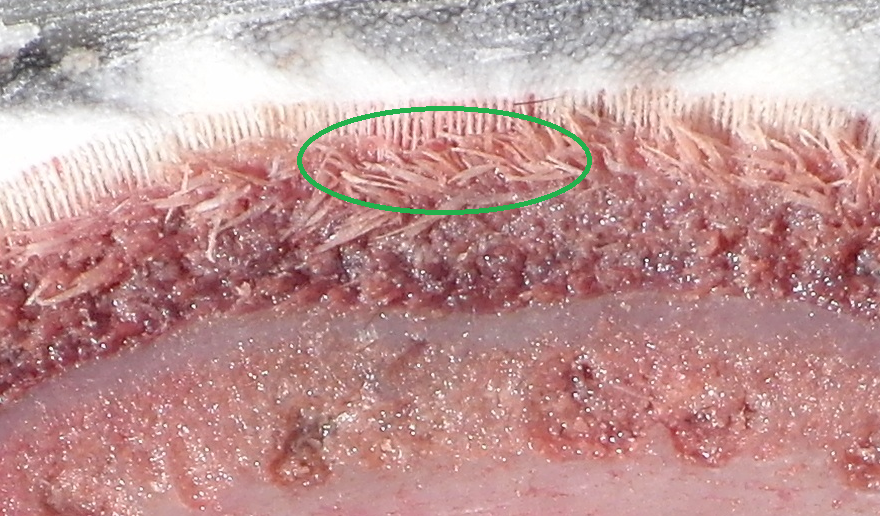
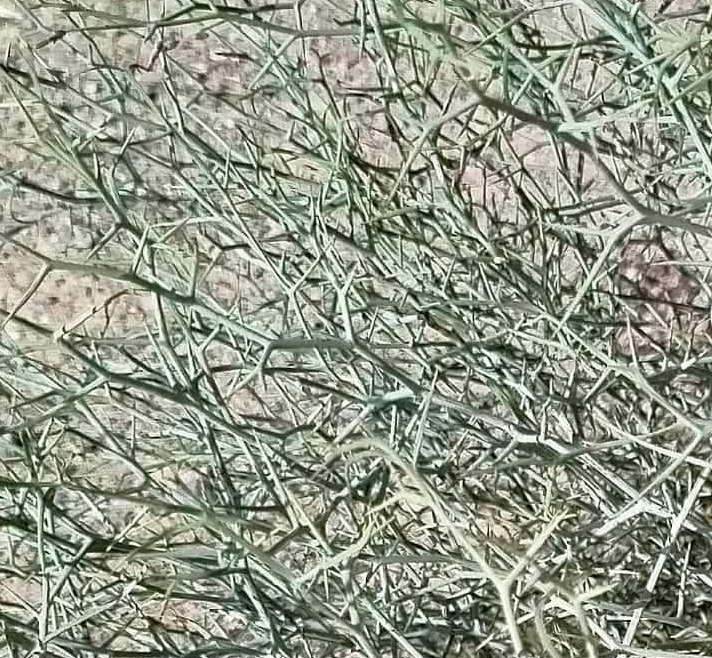
The above picture shows another unstructured network, but this one is not of keratin fibers. It can be stretched and compressed, but it is not good for heavy loads.
Now, I believe you have seen enough evidence to be able to dismantle most traditional theories for the connection between the hoof wall and the coffin bone, but there is even more evidence coming in later sections of the protocol. When laminitis has made the working connective points between the secondary lamellae and the keratin fibers fewer and fewer, the hoof wall becomes looser and looser, and thus more sensitive to high loads from the horse’s weight and ground pressure.
When a laminitic-free hoof is exposed to breaking forces from ground pressure pushing on a long toe, the capsule will be deformed, but slower and less dramatic compared to when a laminitic hoof becomes exposed to the same forces.
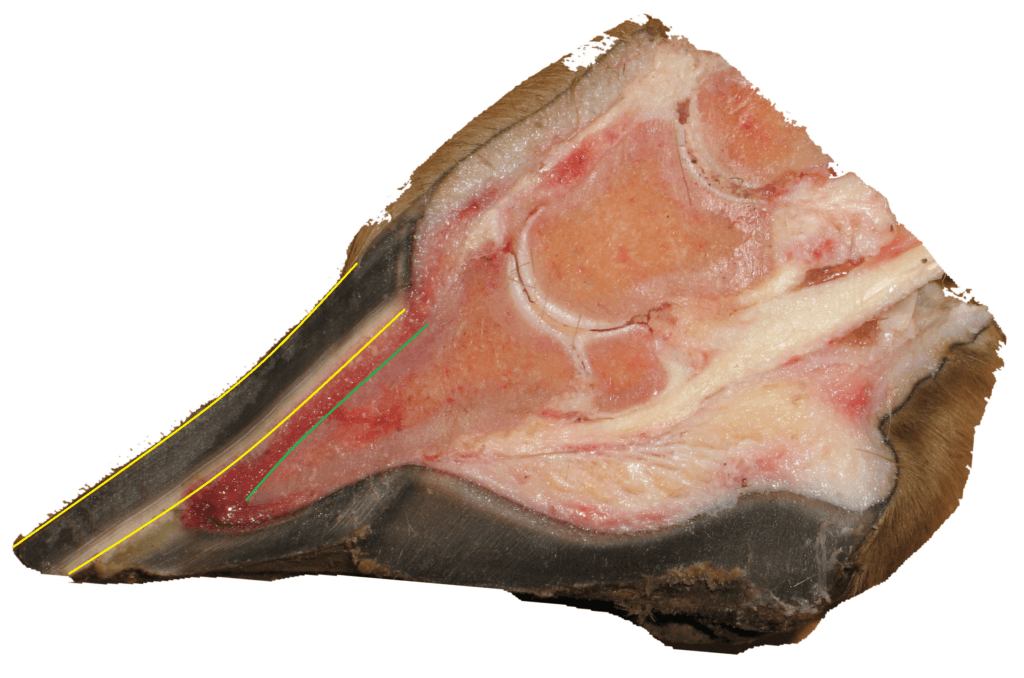
On this long-toed but laminitic-free hoof, we can see that the green and the yellow lines are not parallel, which tells us that the ground pressure has pushed the toe wall up and away from its natural position.
On the below laminitic hoof, we can clearly see that when the ground pressure pushed up the earlier, too-long toe, the toe broke loose from its connection to the hoof. The laminar junction was apparently healthy when this happened, since its connection to the hoof wall was strong enough to stretch the sole forward when the ground pressure pushed up the toe wall. Since the laminar connection was impaired by laminitis, the connection between the lamina and the corium broke. The new void that was created when the toe wall was pushed away was filled with wound fluid, which hardened to scar horn. This scar horn is firmly connected to the primary lamina and will follow the hoof wall wherever it goes, which I will come back to in the section on Coffin bone rotation.
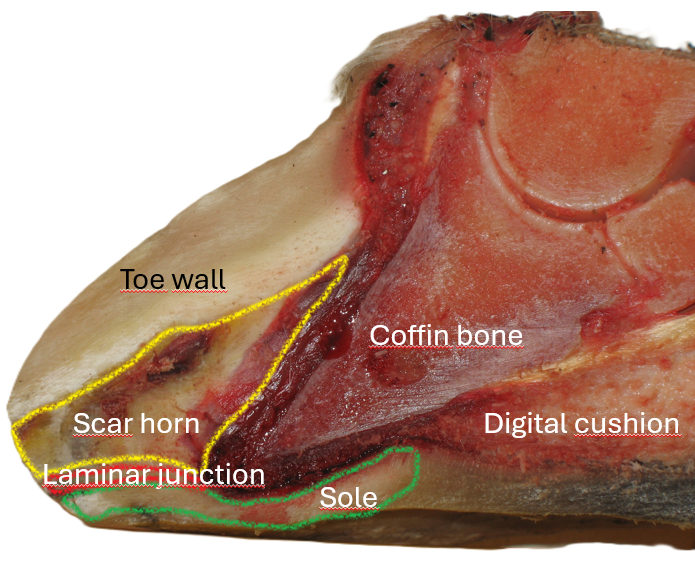
Since the primary lamella is a part of the wall horn, i.e., hoof wall and bars, there are no laminae anywhere else. This explains why the sole and the frog are not affected by laminitis. When people see laminitic horses that seem to be sole sensitive, it is the hoof wall that protests against even the slightest ground pressure they see.
Laminitis is more of a chemical reaction than anything else. There is no cure or treatment for laminitis, but there is no pain or hoof deformation connected directly to laminitis either. All perceived problems are created by physical forces affecting the laminitic hoof. You can find much more on this in The Good Protocol on Coffin Bone Rotation.
There are no treatments for either founder or laminitis.
The only medication the veterinarians can offer a foundered horse is a painkiller and something anti-inflammatory, but there is neither pain nor inflammation associated with either founder or laminitis in themselves. The pain affecting laminitic hooves comes from a side effect of laminitis, but that is something a good trim takes care of much better and more effectively.
No one can do anything to stop or cure the laminitis, but we can both prevent and stop the hoof capsule deformation that is associated with laminitis and responsible for the pain. A hoof deformed during laminitis can not be healed, only grow healthy, and when it has, it is just as strong as it was before it got laminitis.
The good news is that no horse has ever died from either common founder or laminitis.
It is the lack of successful rehabilitation of a side effect of a side effect of founder, i.e., what is called “coffin bone rotation”, that far too often leads to the completely unnecessary death of laminitic horses. Let us change that here and now!
Evidence:
- We know that ground pressure is pressing up long toe walls, and we know that laminitis makes the hoof wall loose. This makes me believe that since 1+1=2, ground pressure + a loose hoof wall = a deformed hoof capsule, which makes the above reasoning logical. Now, continue to The Good Protocol on Coffin bone rotation to save the life of the next foundered pony you will meet.
Conclusions:
- Founder resides in the horse’s body, and laminitis resides in the hooves.
- Founder is a pass-through stage that the horse usually takes care of by himself in four days. It is the lack of effective trimming that leads to long-term consequences.
- Laminitis is more of a chemical reaction stopping a function than an inflammation (swelling for healing).
- Laminitis doesn’t create hoof deformation. It is the ground pressure on a laminitic hoof wall that does.