Equine Physics is not a trimming technique or a hoof care method; It describes the Physics and the Laws of Nature that all techniques and methods must apply to because if physics doesn’t apply to horses, you can be sure they would fly.
Golden standard or total misunderstanding?
Purpose
- Explain what they mean when they talkabout the toe axis.
- Explain the physics for and against the toe axis to make you understand what is right and what is completely wrong.
They say that if you draw a line through the lower three skeletal bones in a horse’s leg, the line must be straight, and the bones must be aligned. They also say that if this is not the case, you are supposed to correct this by changing the height of the heels.
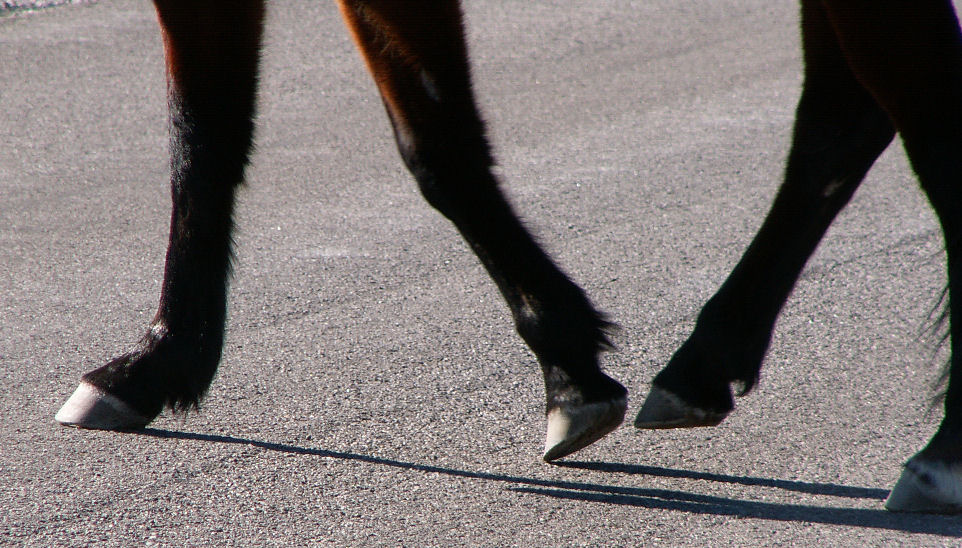
Toe axis, broken or not, is a purely theoretical concept. They say that the lowest three phalanges (P1, P2, P3) in the horse’s leg are supposed to be aligned (as the red line in the picture below) or the horse is suffering from a broken toe axis. There are multiple problems with this reasoning. As you can see in the picture above, there is no standard or fixed angle on the lower three phalanges when the horse is moving. It is alldepending on the loading of the hoof. Yes, I’ve heard that you are supposed to check the toe axis when the horse is standing still, in balance, on a flat surface. But why, when standing still on a flat surface, are stresses and strains the smallest? Even if you have your horse standing still on a flat surface, the toe axis will change as soon as he looks to the side. And how do you check the angles of the skeletal bones when the only thing you can see is fur, and a hoof capsule that is only loosely connected to the coffin bone (yellow line). These are, however, just details because the main argument against the toe axis is that there is no force going in the direction of the theoretical toe axis, ever, which makes the complete reasoning about the toe axis completely irrelevant.
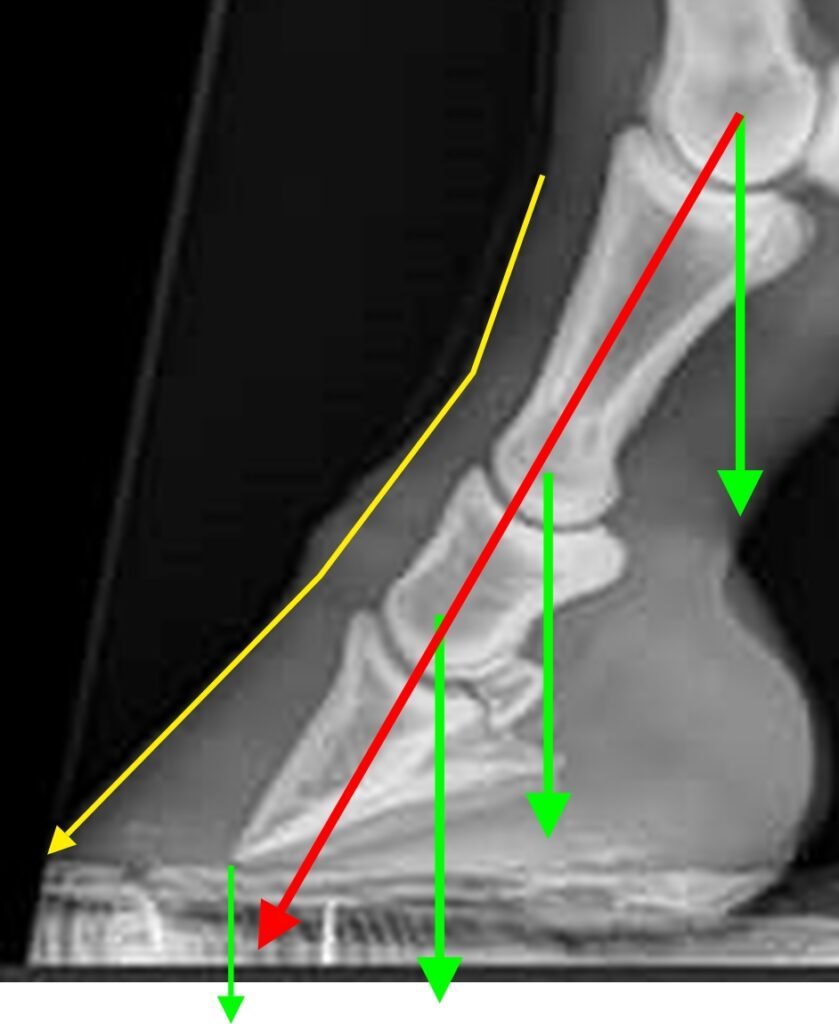
Let me prove that to you:
If there were a force following the red line, it would also follow the wooden plank that the weight in this video is placed on, and if that were the case, the trolley would roll to the left by itself, but it doesn’t.
The reason for this is that according to Newton’s Law of Universal Gravitation is defined as “a force that works in a straight line between the centre of two objects”, which in our case is between the centre of the weight and the centre of the Earth, i.e. straight down.
The explanation for why this trolley isn’t rolling to the left by itself is that there is no force pushing it in that direction. The only force that is active is the gravitational force working in a straight line between the centre of the weight and the centre of the Earth, which doesn’t cause the trolley to move.
When we add an artificial force in the direction of the wooden plank the weight is resting on, the trolley directly rolls to the left.
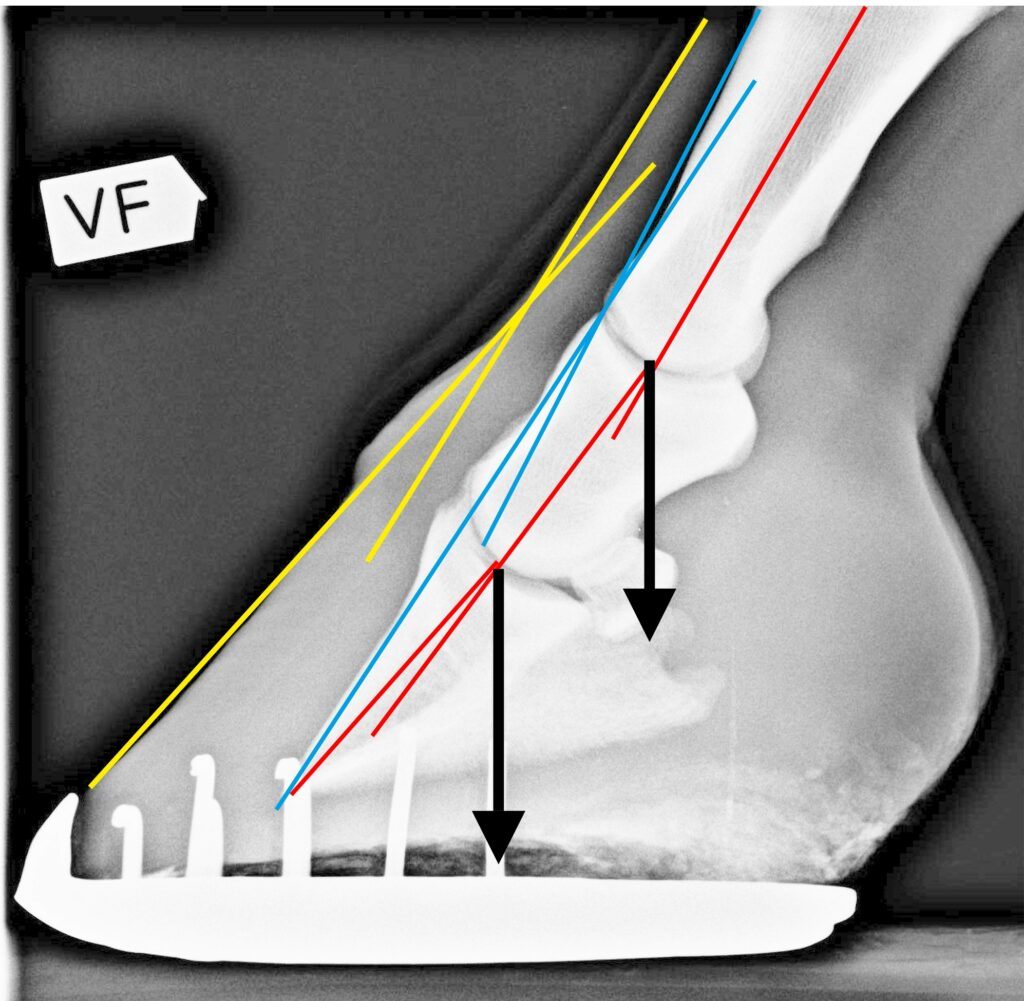
The yellow lines are what you can see: fur and hoof capsule.
The blue lines are the outside of the skeletal bones (which would be closest to what you can see from the outside), but they are not parallel to the yellow lines, and you can’t see them from the outside.
The red lines, which are the only things that could have any relevance, are still just lines since there is no forces going in that direction.
The force created by the horse’s weight and gravity that is pushing the hooves to the ground is always aimed straight down, regardless of the angles of the hoof capsule, the fur, and the skeletal bones. The skeletal bones are to be considered building blocks kept together by ligaments and muscles, but the force transferring the weight from the bulk of the horse to the ground is always angled straight towards the centre of the Earth (black arrows).
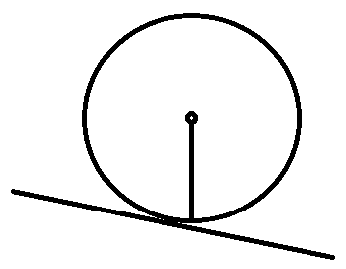
Q. Why does a car that is parked on a road going uphill roll backwards when you loosen the handbrake? A. Gravity caused by the weight of the car will pull the centre of the wheel towards the centre of the Earth. This line will touch the outer surface of the tyre behind the centre of the contact area between the tyre and the pavement, which will make the wheel start rolling backwards.
Evidence
- All weight-bearing (gravitational) forces aim for the centre of the Earth. This is considered a law of nature.
Conclusion
- Disregard completely.
- The toe axis is purely of cosmetic value and has absolutely nothing to do with horse health.
- Changing the heel height will directly alter the hoof mechanism, which affects the blood circulation and the health of the hoof.