Equine Physics is not a trimming technique or a hoof care method; It describes the Physics and the Laws of Nature that all techniques and methods must apply to because if physics doesn’t apply to horses, you can be sure they would fly.
Purpose
This segment will explain the physics behind why a traditionally shaped laminitic hoof becomes deformed, impaired, and afflicted by pain, while a correctly shaped hoof suffers none of the above.
What happens in the hoof when it gets laminitis?
First, we must understand how the hoof is “put together” and what is attached to what. The skeleton bears the horse’s weight, and all the forces created by what we call weight (mass times gravity) point toward the center of the planet (i.e., straight down). The bones in the skeleton thus push directly downward against each other, causing all the weight to ultimately load the coffin bone in the hoof joint.
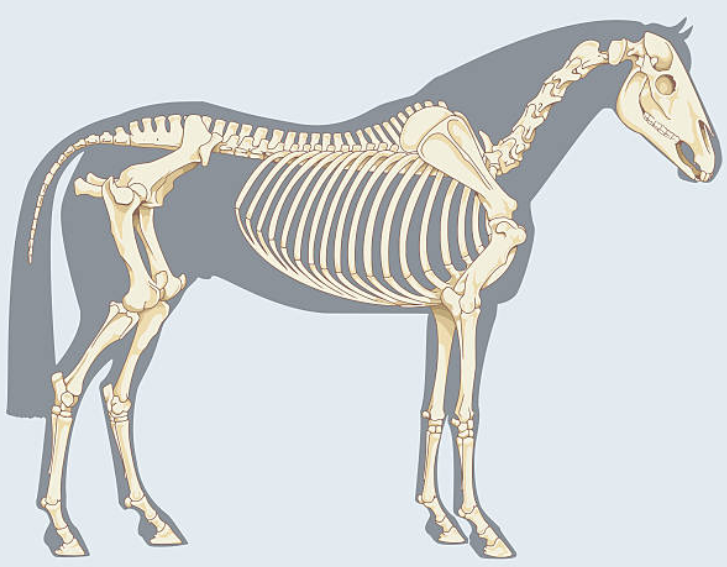
This means that the force created by the horse’s weight causes the coffin bone to press the sole corium directly down toward the sole, making the hoof sink into the ground until the ground pressure equals the pressure from the horse’s weight, and the hoof stops sinking.
When a barefoot hoof sinks into the ground, the pressure is distributed across the entire underside of the hoof, which reduces the load per unit area. Everything that leaves a footprint is being pressed up by ground pressure.
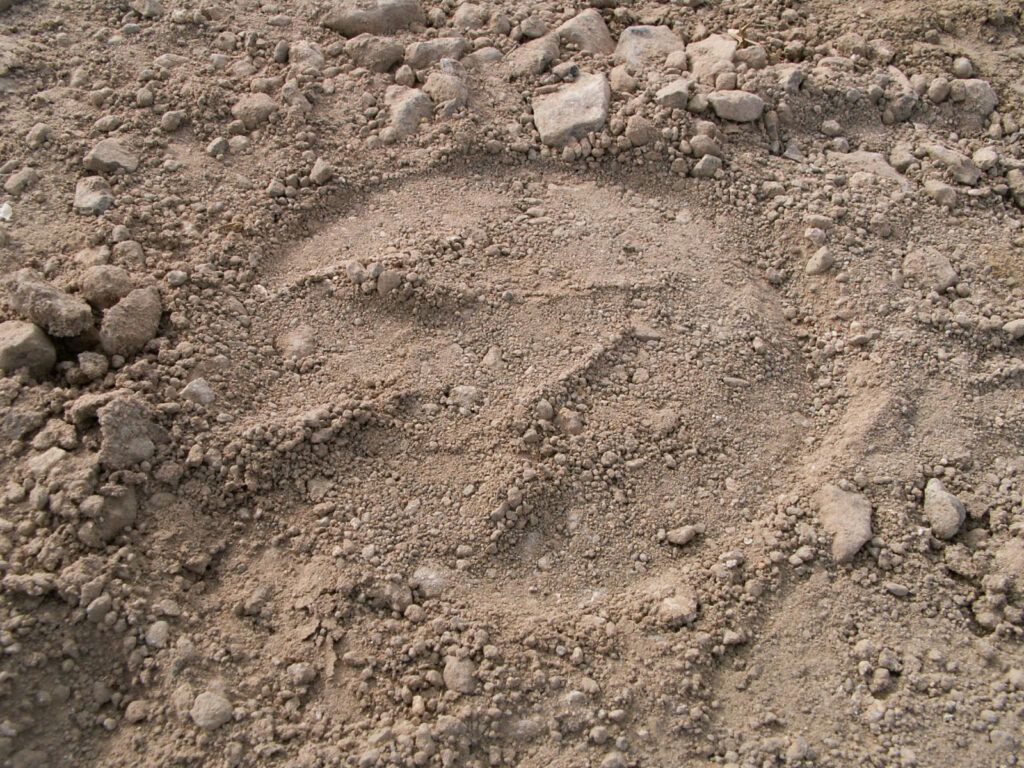
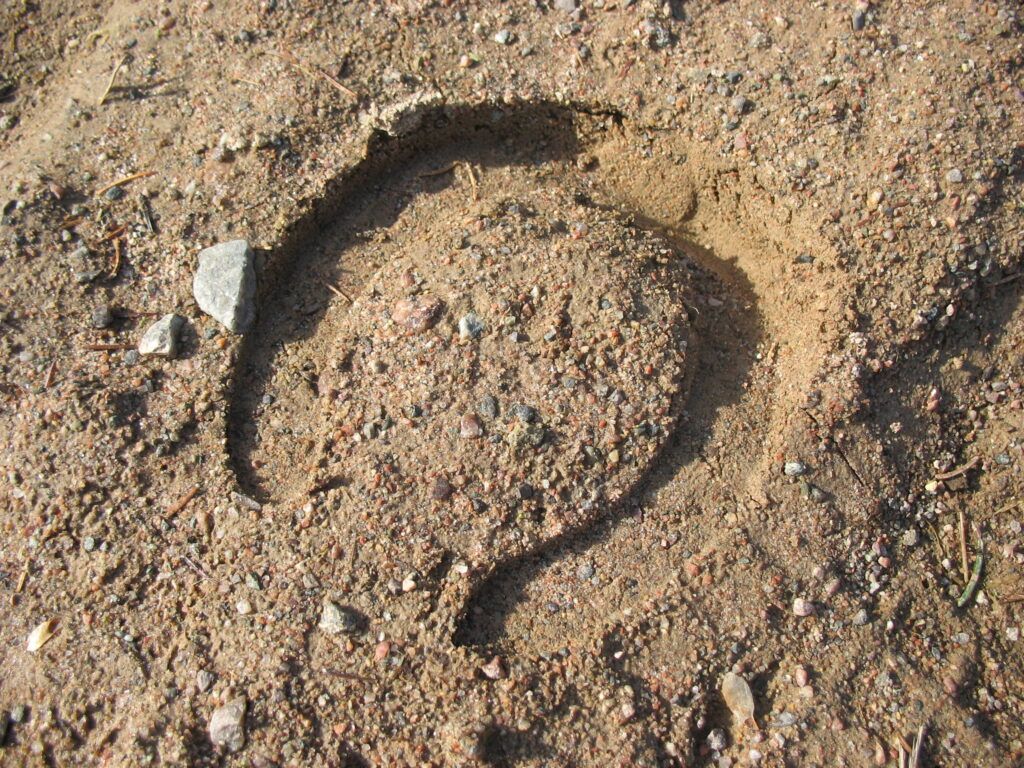
This picture was taken outside my neighbor’s farm, where humans affect everything about the hoof shapes and how they are loaded.
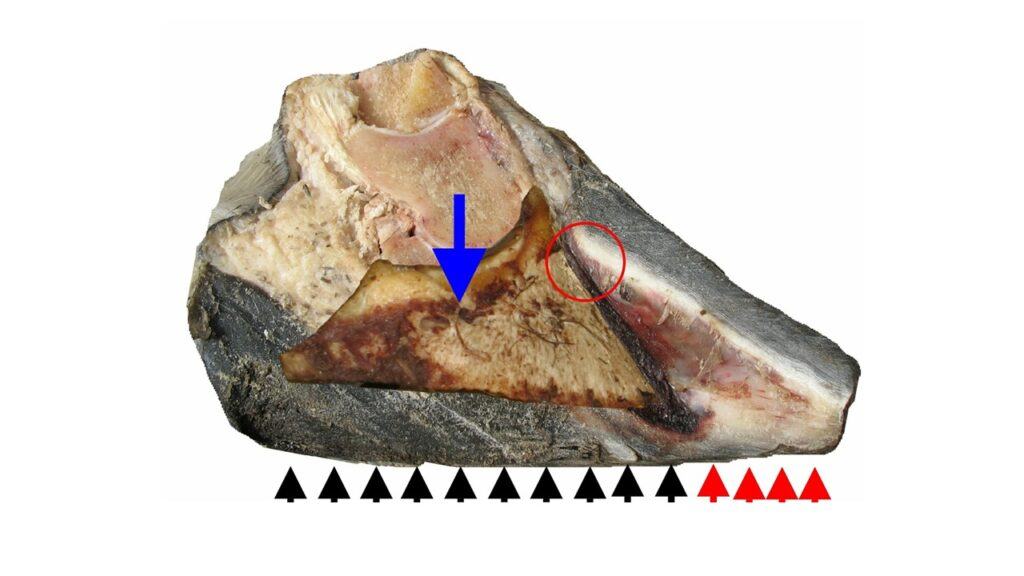
Everything that leaves a footprint is being pushed up by ground pressure (the arrowheads). The part of the hoof that is right under the coffin bone will be nicely affected by balanced forces from the horse’s weight and ground pressure, which will only result in compression of the sole corium (which creates blood circulation, but more about this in the section on hoof mechanism). If the hoof is larger than the coffin bone, the oversized part of the hoof will be pushed upward by the ground pressure (Red arrows) without any natural forces balancing it. This means that the outer part of the sole and the hoof wall will bend and stretch the sole since there is no weight pressing it down.
The same applies if the hoof is shod and the hoof wall extends below the sole level, thus bearing weight. When the hoof wall is pushed upward relative to the coffin bone and the part of the sole beneath the coffin bone, the sole will be stretched. If the laminar junction is sound, pushing up the hoof wall will create stretching, thinning, and bending of the sole until it breaks.
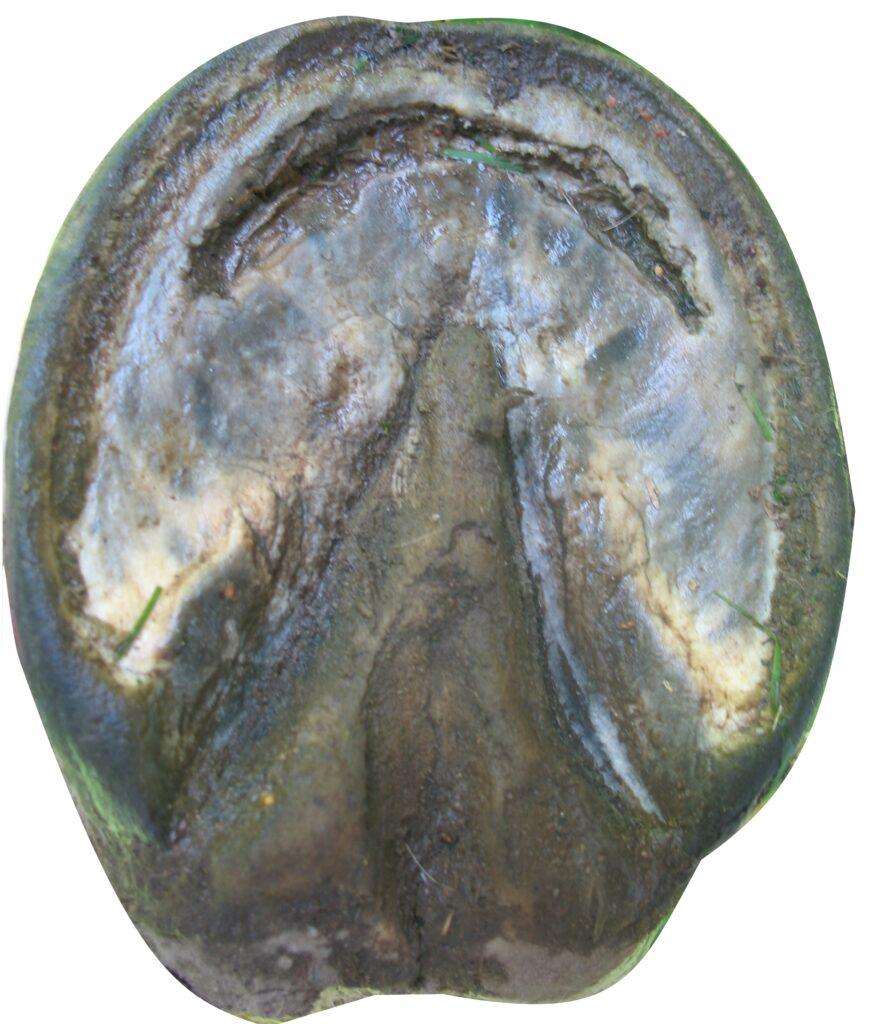
If the laminar junction is already impaired when laminitis strucks the hoof wall will be pushed out and up by the ground pressure, breaking the capsule loose from the rest of the hoof. What angle the capsule then takes depends completely on the hoof shape.
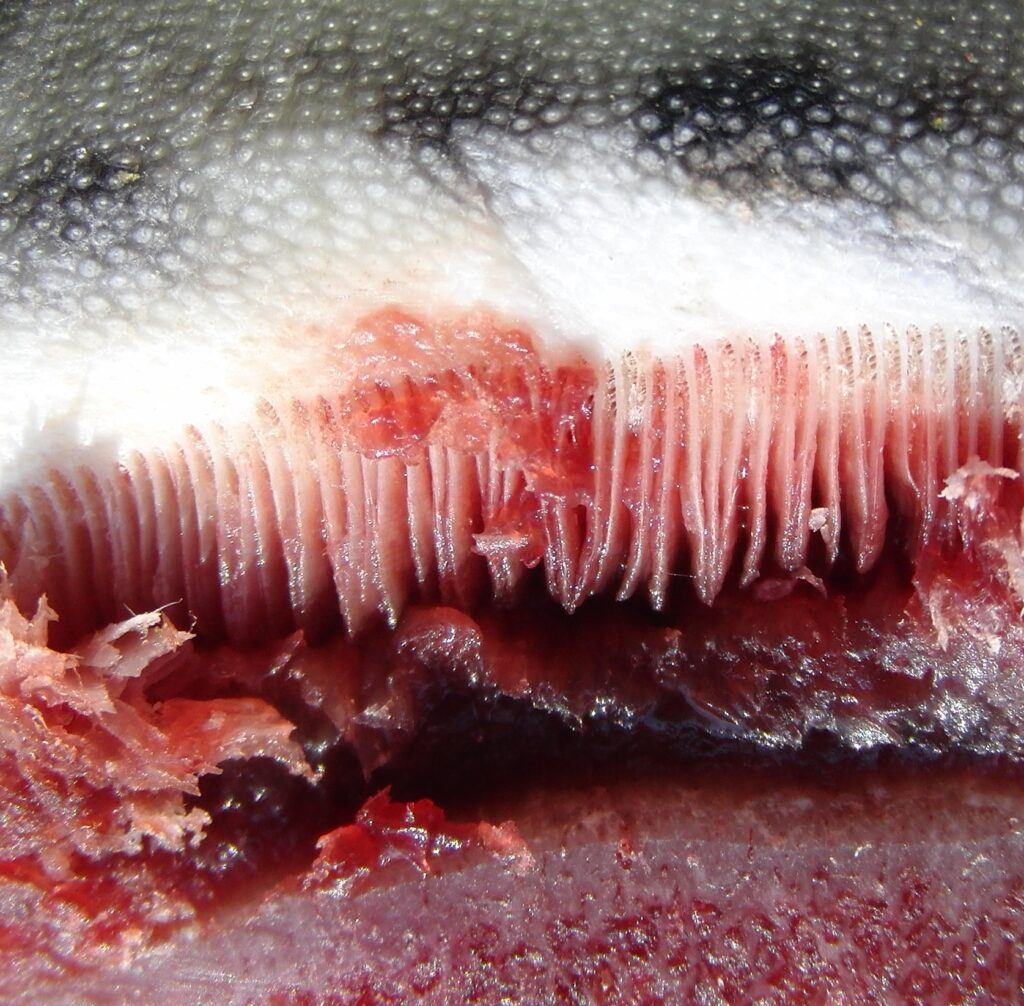
This very much enlarged picture shows a hoof wall with laminea that has been torn away from the coffin bone.
From the top: Hoof wall, laminae, what used to be corium, coffin bone.
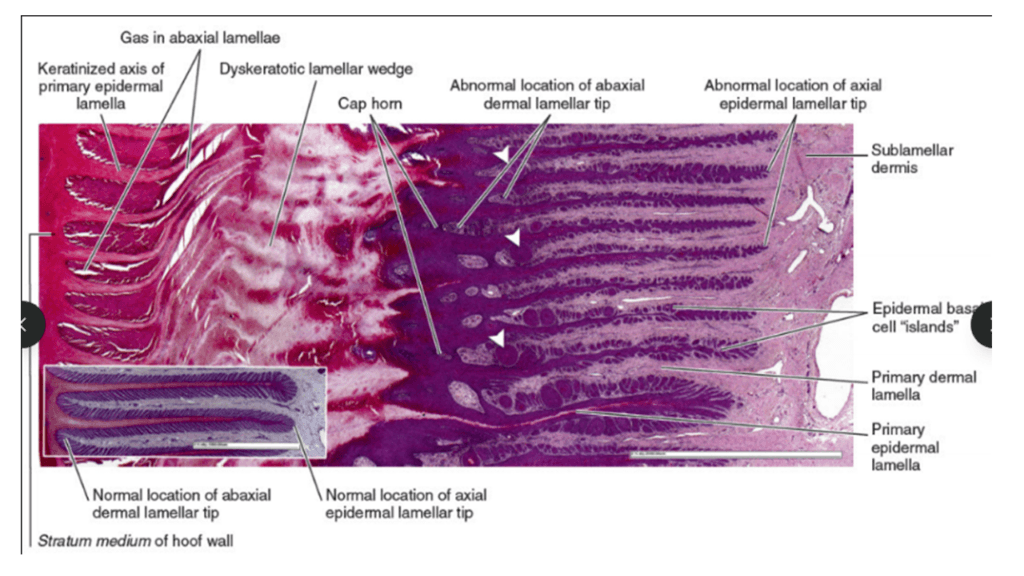
From the left, we can see the hoof wall with its wine-coloured primary lamella meeting the rounder tips of the darker blood-filled corium. The lighter section is where the laminitic laminae have been pulled apart and broken. The almost white parts are wound serum that later will harden into a laminar wedge/scar horn. Specially interesting to see is that the breakage has taken place where the keratinized primary lamella has become very thin and mixed with blood-filled corium. This area must be where the primary lamella, secondary lamella, and the keratin fibers meet, not further to the right where the soft tissue meets the coffin bone. I’m afraid that the above picture was turned upside-down before the text was added, because if we turn it, the direction the different parts have been moving becomes both obvious and logical. We can clearly see that the hoof wall (to the left) has been flexing up and then down again, most likely due to ground pressure on the toe wall, while the coffin bone to the right doesn’t look like it has moved much at all since the soft tissue (the corium) still is almost perfectly horizontal.
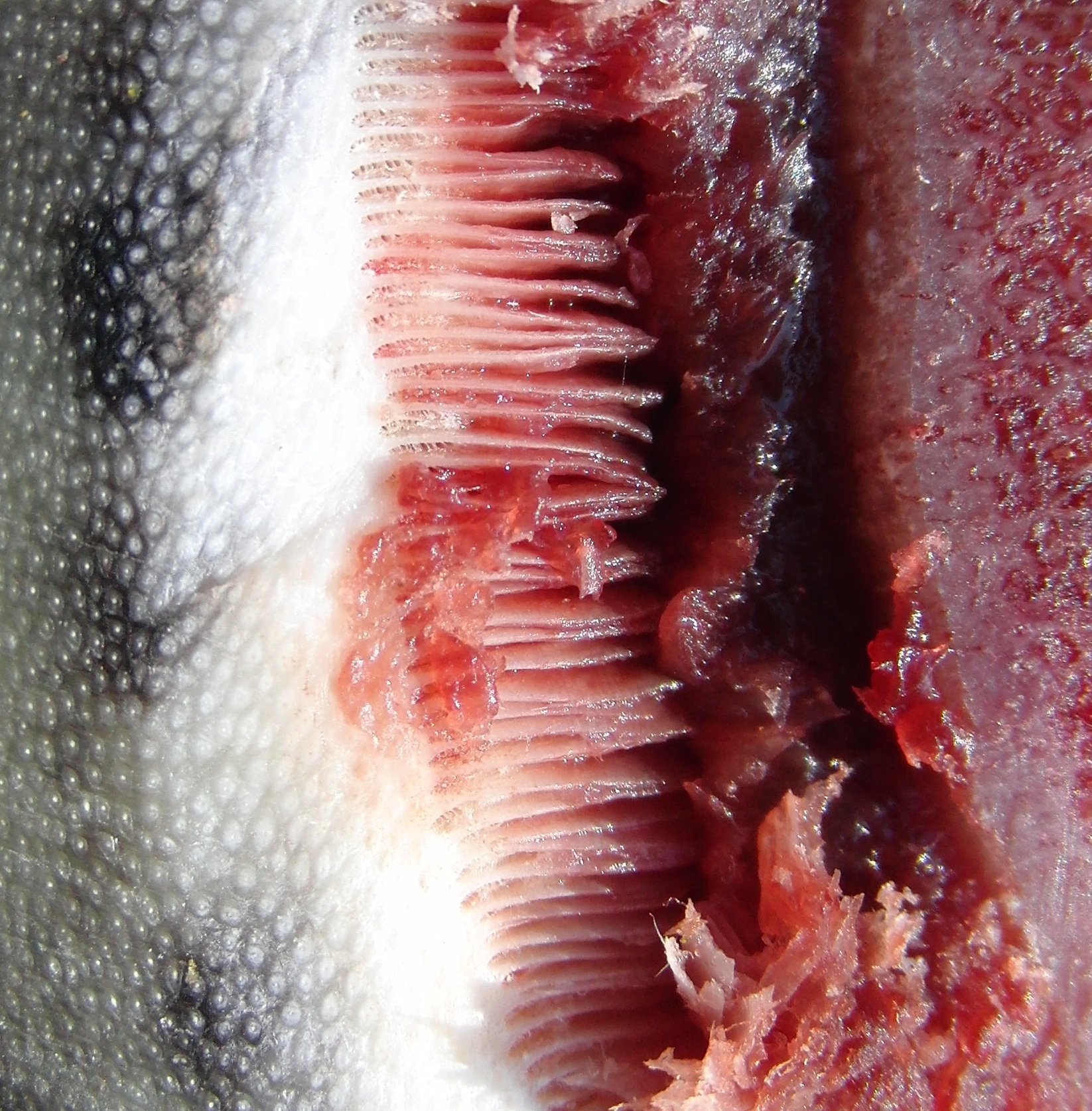
becomes clear that in a laminitic hoof, where the connection between the hoof wall and the hoof has been broken, the hoof wall will be broken loose and pushed upward relative to all other parts of the hoof/horse by the ground force. This can be misunderstood as the coffin bone was sinking when it is the loose hoof wall that has been pushed up compared to everything else.

The blue arrow represents the horse’s weight, and the red area shows where the corium should be connected to the coffin bone.
If the coffin bone were to “hang” from the red area, the back part of the bone would be more prone to “rotating” down since there is almost no area of connection between the coffin bone and the hoof wall behind the pressure point? That is, if there had not been a sole pressed to the ground below, of course.

As stated before, the horse’s weight is supposed to be transferred to the ground by the coffin bone pressing directly down on the corium, the sole, and finally the ground. But in what way would the weight go in a hoof where the hoof wall, due to metal shoes or protruding hoof walls, has been made weight-bearing?
Yes, I know that the tradition states that the coffin bone is hanging from the hoof wall by the laminae, but is that even possible?
Let us first look at what the tissue between the coffin bone and the hoof
If the sole doesn’t make ground contact when loaded, the horse’s entire weight is forced to find another path from the coffin bone to the ground.

The sad truth is that the whole horse will then stand on a” trampoline” (like the one kids are jumping on). ” If the hoof wall is the only part of the hoof with ground (shoe) contact
the weight will have to choose an odd way (red arrows) to reach the ground.
(Red arrows are pushing forces and blue arrows are pulling forces.)
The weight comes in the skeleton down to the coffin bone (big red arrow) that always stands on the sole corium and the sole.
If the sole doesn’t make ground contact, the sole hangs from the hoof walls by the band of laminars.
This means that the band of laminars is suspending the whole horse,
and the sole becomes overloaded, bent, and stretched.

The above picture shows a hoof where the sole made ground contact when the hoof was loaded. Remember the relation between the yellow line and the green line here, and look at the next picture.
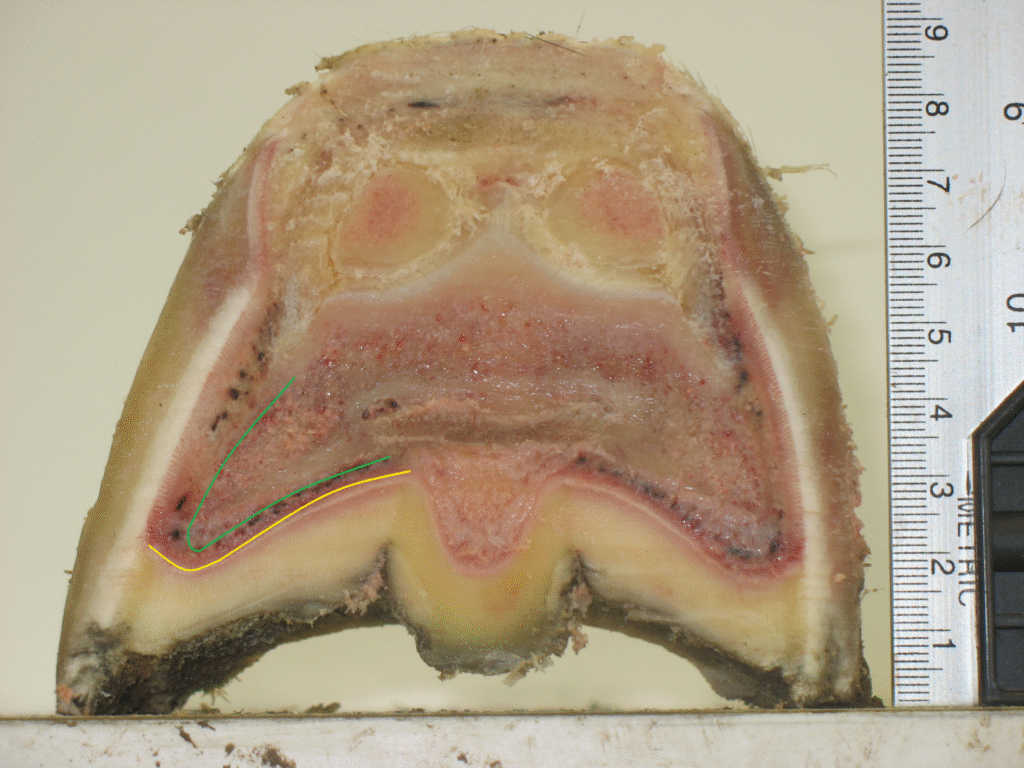
This is a picture of a hoof where the high hoof walls made it impossible for the sole to make ground contact when loaded. Because the sole didn’t get any support from the ground, the coffin bone pressed down on the sole from where it connects to the hoof wall. The hoof wall was pushed up by ground pressure, and the coffin bone was pressed down by the horse’s weight, which permanently deformed the sole
The reason the weight doesn’t go from the coffin bone through the lamellae, out to the hoof wall, as the tradition states, is that it would be even worse.
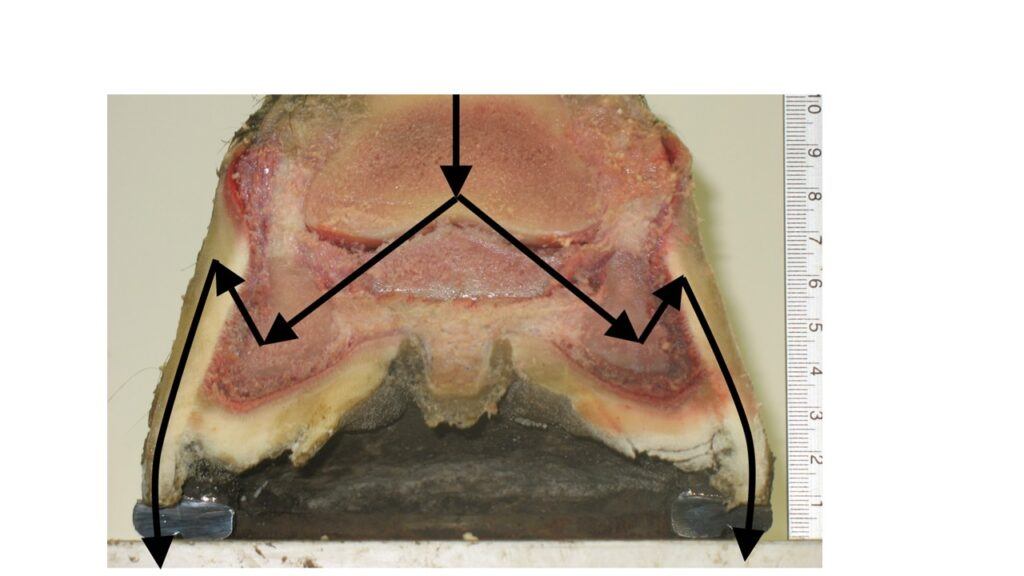
The above picture shows what the tradition states about how the horse’s weight reaches the ground. During this class, I will gradually stack up a pile of reasons and evidence that the tradition is completely wrong, and that is the main reason why so many horses lose their life due to hoof complications.
Let me give you one more here. If you want to lift something with a rope, the rope must go straight up from the object you want to lift, or you will get problems. If you are using one rope and it doesn’t go straight up, you will drag the object to the side instead of lifting it. If you use two ropes, each one at a 45-degree angle, the force in each rope will be approximately 1.4 times higher compared to if the ropes had gone straight up.
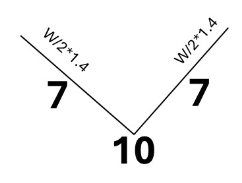
If you don’t believe me, ask Chat GPT, “What will happen to the forces if I want to lift an object using two ropes going 45 degrees to the side instead of straight up?”
So what does this have to do with hooves?
Okay, if the laminae were intended to lift the coffin bone (the whole horse), they would have gone straight up from the bone, but do they?
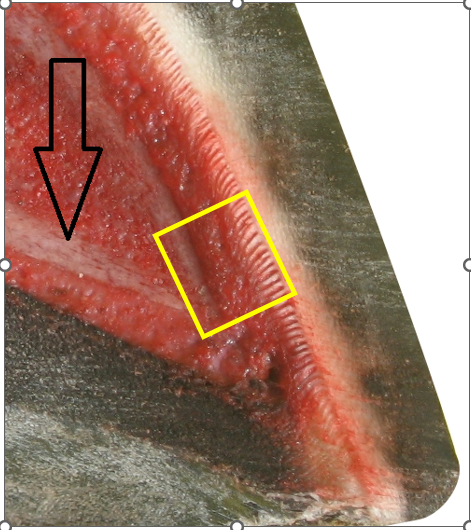
To me, it looks like they are much more angled perpendicular to the hoof wall (straight out from) than vertical (like the black arrow). This means that their job is to absorb forces going 90 degrees to the hoof wall, like keeping the hoof capsule in place when the horse is taking a sharp turn, not lifting the coffin bone.
Pain relief connected to laminitis is achieved when ground pressure no longer breaks the hoof wall away from the coffin bone. This means trimming the hoof to leave as small hoof prints as possible. Small hooves = less leverage for the ground pressure = less pain.
This means that the hoof below must be reduced by trimming far into the sole from the front and sides to remove the leverage that a too-big hoof capsule brings.
The coffin bone in the picture is the original one (no Photoshop).
Use your imagination for how much you could trim.
The most I’ve ever shortened a Shetland pony’s hoof
(which did not appear to have a stretched band of laminar)
was to be half its length.
However, it takes special training to reduce hoof size by trimming into the sole.
It’s often possible to trim away much more than traditional methods allow—but this is not a job for the untrained. I have done hundreds of extreme toe shortenings, and my students have done just as many, all without a single drop of blood. Drawing blood is only for the ignorant
There are various signs in the hoof that, when considered together, can make even very radical trims completely safe and highly effective in relieving pain. A trim that relieves pain does so by removing the cause of the pain, while chemical pain relief only masks the cause.
A correctly performed trim for laminitis will let the horse voluntarily gallop in the paddock within 20 minutes after the trim. Riding can then begin as soon as the horse allows it, since the cause of the pain has been trimmed away, and there is no risk involved anymore. However, it is important to remember that the hoof is not healthy just because it is pain-free. A hoof that has been deformed after laminitis cannot heal. All damaged tissue must be replaced, and therefore, the hoof remains vulnerable to new deformation until the new hoof capsule has completely replaced the old one. During this regrowth, which replaces the damaged tissue with new, the hoof must be kept extremely well-trimmed for the horse to be exercised or ridden. The hoof wall must never be allowed to bear weight. This also means that under no circumstances should a laminitic hoof ever be shod.
- If the horse doesn’t gallop shortly after being trimmed, the hoof capsule is likely still bearing weight.
- If the pulse persists or returns after trimming, even though the hoof wall looks unloaded, the hoof is likely still too large.
Evidence:
- The laminar can’t carry the weight of the horse since they are not aligned with the force (vertical).
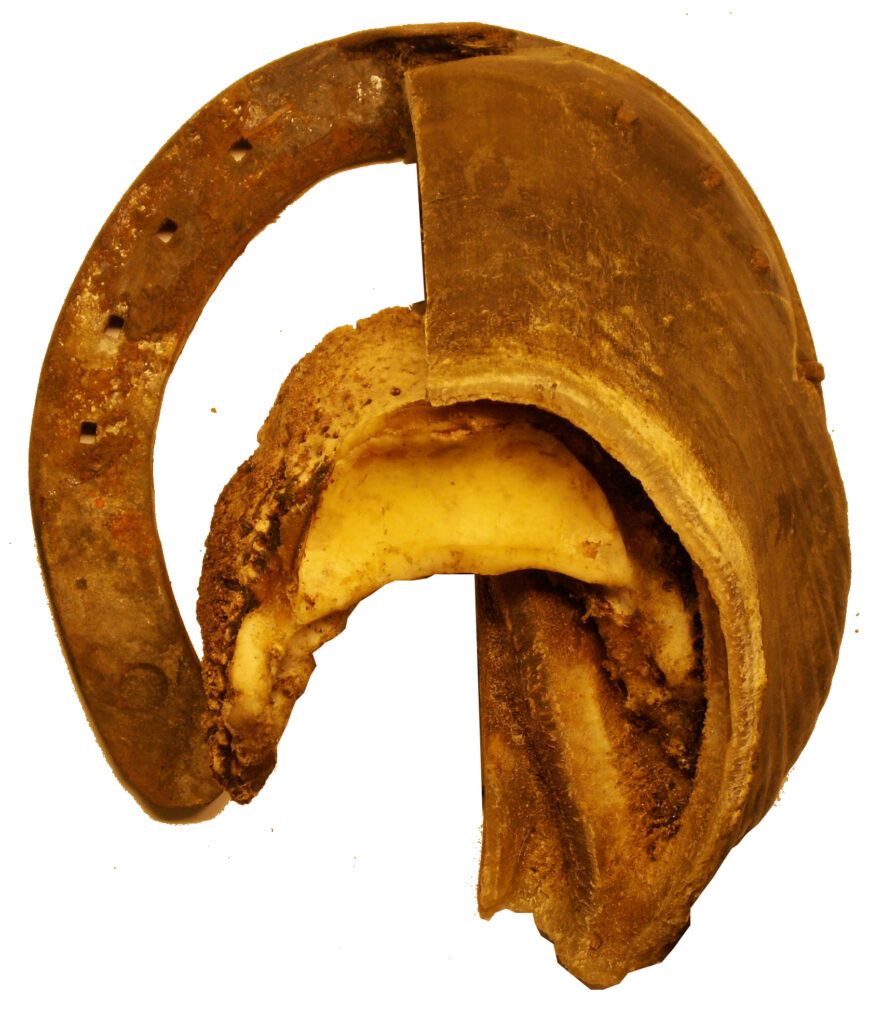
- A cross-section of a shod hoof shows that the weight-bearing coffin bone has deformed the sole.
Conclusions:
- The perfect trimcuts the connection between laminitis and deformed hooves.
- A trim that reduces leverage removes the cause of the pain, while chemical painkillers only mask the pain.